.png)
Effect of Mineral Gypsum and Synthetic Gypsum on Cement Strength and Durability


Cement produced using synthetic gypsum from sulphuric acid processes shows better strength and durability than cement made with natural mineral gypsum. This is mainly due to its finer and more uniform particle size, which improves dispersion and accelerates hydration, resulting in a denser and stronger cement structure.
In comparison, mineral gypsum often contains coarser particles and impurities that reduce hydration efficiency and limit strength development. Therefore, synthetic gypsum is a more effective set regulator for improving cement performance.
1. Materials and mixed proportions
Materials
The experimental study used Ordinary Portland Cement (OPC, 43 Grade) conforming to IS 269:2015 as the base binder. Clinker, mineral gypsum, and synthetic gypsum were proportioned according to the designed mix compositions. Cement-grade clinker and gypsum were used, while synthetic gypsum was produced industrially by reacting lime powder with sulphuric acid.
Standard Ennore sand (IS: 650) was used as fine aggregate, and clean potable water (IS: 456) was used for all mixes. Materials were accurately weighed, mixed in a laboratory mixer, and prepared following BIS guidelines.
OPC 43 grade cement served as the control mix, with a water–cement ratio of 0.43 as per IS 456:2007. The cement was fresh and lump-free, and its physical properties are presented in Table 1.
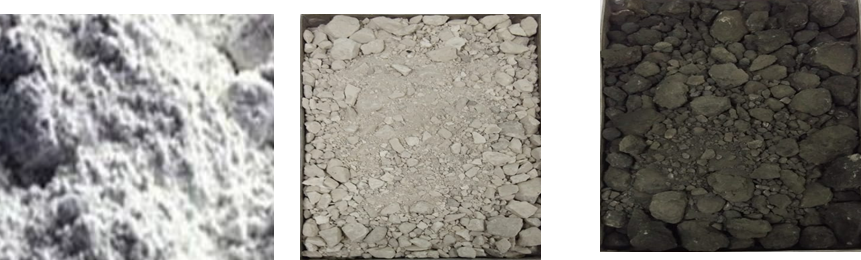
Synthetic Gypsum | Mineral Gypsum | Clinker |
Table-1 Chemical parameter tested by XRF as per IS 12803 :1989
Composition (%) | Clinker | Synthetic Gypsum | Gypsum |
LOI | 0.35 | 16.66 | 16.2 |
SiO2 | 21.07 | 14.6 | 20.77 |
Al2O3 | 5.45 | 3.2 | 0.62 |
Fe2O3 | 4.25 | 2.45 | 2.24 |
CaO | 63.56 | 34.2 | 32.75 |
MgO | 2.13 | 2.09 | 1.4 |
Na2O | 0.38 | 0.56 | 0.12 |
K2O | 0.4 | 0.49 | 0.14 |
SO3 | 1.5 | 24.5 | 25.02 |
Table 1. presents the chemical composition of clinker, gypsum, and synthetic gypsum as determined by XRF analysis. The chemical composition of clinker, gypsum, and synthetic gypsum reveals important insights into their suitability for use in cementitious systems.
Mixed proportions
Table -2 Different mix proportion for cement production as per IS 4031
Recipe | 93 % Clinker + 7% Mineral Gypsum) | 93% Clinker +7 % Synthetic Gypsum) |
Normal Consistency (%) | 28.5 | 28 |
Fineness | 340 | 360 |
IST | 145 | 145 |
FST | 195 | 190 |
3 Days | 24.5 | 25.7 |
7 Days | 35.8 | 37.9 |
28 Days | 45.2 | 47.8 |
The table compares cement made with 93% clinker and 7% mineral gypsum to cement made with 93% clinker and 7% synthetic gypsum, tested as per IS 4031. The results show that gypsum type significantly affects cement properties and strength.
Cement with synthetic gypsum shows slightly lower normal consistency (28.0%) than mineral gypsum cement (28.5%), indicating lower water demand and better paste density. It also has higher fineness (360 m²/kg vs. 340 m²/kg), which improves hydration and strength development.
Both mixes have the same initial setting time (145 minutes), while the synthetic gypsum mix has a slightly lower final setting time, indicating faster hardening without affecting workability.
Compressive strength is higher for synthetic gypsum at all ages: 25.7 MPa at 3 days, 37.9 MPa at 7 days, and 47.8 MPa at 28 days, compared to 24.5 MPa, 35.8 MPa, and 45.2 MPa for mineral gypsum.
The superior performance is due to finer particle size, uniform composition, improved hydration, and reduced porosity. Overall, synthetic gypsum is a suitable and performance-enhancing alternative to mineral gypsum, meeting IS 4031 standards while providing better strength and durability.
Particle size distribution

The figure compares the particle size distribution (PSD) of mineral gypsum and synthetic gypsum, highlighting differences in fineness and uniformity that affect cement performance.
Mineral gypsum shows a coarser and broader PSD, with more medium-to-large particles. This reduces packing efficiency and increases capillary porosity in cement.
In contrast, synthetic gypsum has a finer and more uniform PSD, with a higher proportion of fine particles. This improves particle packing, fills micro-voids, and enhances matrix densification.
The finer particles of synthetic gypsum dissolve faster and interact more effectively during hydration, leading to improved pore structure, lower permeability, and better durability.
Overall, PSD analysis confirms that the finer and more uniform nature of synthetic gypsum is a key factor behind its superior strength and durability in cement production.
2. Compressive Strength of cement mortar

The compressive strength of cement mortar prepared with mineral gypsum and synthetic gypsum was evaluated at 3, 7, and 28 days. The results show that synthetic gypsum consistently improves strength at all curing ages.
At 3 days, mortar with synthetic gypsum achieved 25.2 MPa, slightly higher than 24.5 MPa for mineral gypsum, indicating better early-age hydration. At 7 days, strength increased to 36.8 MPa compared to 35.8 MPa, reflecting improved particle dispersion and hydration. At 28 days, synthetic gypsum mortar reached 46.5 MPa, exceeding the 45.2 MPa of mineral gypsum, indicating a denser and more compact structure.
The higher strength is attributed to the finer particle size, uniform composition, improved hydration efficiency, and reduced porosity of synthetic gypsum. Overall, synthetic gypsum proves to be an effective alternative to mineral gypsum, providing better strength and durability in cement manufacturing.
3. Water absorption

The figure compares the water absorption of cement made with mineral gypsum and synthetic gypsum, which reflects pore structure and durability.
Cement with mineral gypsum shows a water absorption of 9.20%, while cement with synthetic gypsum records a lower value of 8.40%, indicating a denser microstructure.
This reduction is due to the finer and more uniform particles of synthetic gypsum, which improve packing and hydration, refine pores, and reduce connected voids. As a result, water penetration is limited.
Lower water absorption enhances durability by restricting the entry of harmful agents. Overall, synthetic gypsum improves the impermeability and long-term performance of cement, making it a suitable alternative to mineral gypsum.
4. Durability

The graph illustrates the durability performance of cement containing 7% mineral gypsum and 7% synthetic gypsum when exposed to water curing, acidic medium, and basic medium at 7 days and 28 days.
At 7 days, cement with synthetic gypsum shows slightly higher strength in all environments compared to mineral gypsum. Under water curing, the strength is 36.3 MPa for synthetic gypsum and 35.2 MPa for mineral gypsum. In the basic medium, the values are 35.8 MPa and 34.9 MPa respectively, while in the acidic medium they are 35.6 MPa and 34.6 MPa. A slight reduction in strength is observed in acidic and basic conditions compared to water curing, but the difference is minimal.
At 28 days, the strength of both cement types increases significantly, indicating normal hydration and strength development over time. Under water curing, the strength reaches 47.0 MPa for synthetic gypsum and 45.8 MPa for mineral gypsum. In the basic medium, the values are 46.3 MPa and 45.2 MPa, while in the acidic medium they are 45.9 MPa and 44.9 MPa respectively. Again, synthetic gypsum consistently shows about 1 MPa higher strength than mineral gypsum in all environments.
Overall, both types of gypsum demonstrate good durability in acidic and alkaline environments, with only minor strength reductions compared to water curing. However, cement containing 7% synthetic gypsum exhibits slightly better performance and long-term durability than cement with mineral gypsum.
5.Conclusion
This study evaluated the effects of mineral gypsum and synthetic gypsum produced through sulphuric acid processes on cement properties in accordance with IS standards. The results clearly show that synthetic gypsum performs better than mineral gypsum as a set regulator.
Synthetic gypsum has a finer and more uniform particle size, which improves packing, dispersion, and hydration, leading to a denser microstructure with reduced porosity. Its use slightly reduces normal consistency, increases fineness, and maintains proper setting time, confirming compliance with IS 4031.
Cement with synthetic gypsum showed higher compressive strength at 3, 7, and 28 days due to improved pore structure and better formation of hydration products. Water absorption was also lower, indicating reduced permeability and enhanced durability.
Durability tests under water, acidic, and alkaline conditions demonstrated higher retained strength for synthetic gypsum-based cement, reflecting better resistance to chemical attack.
Overall, synthetic gypsum is a technically superior and sustainable alternative to mineral gypsum, providing improved strength, lower water absorption, and enhanced durability while meeting all relevant Indian Standards.
Written by Dr. Dalpat Singh Chundawat



Comments